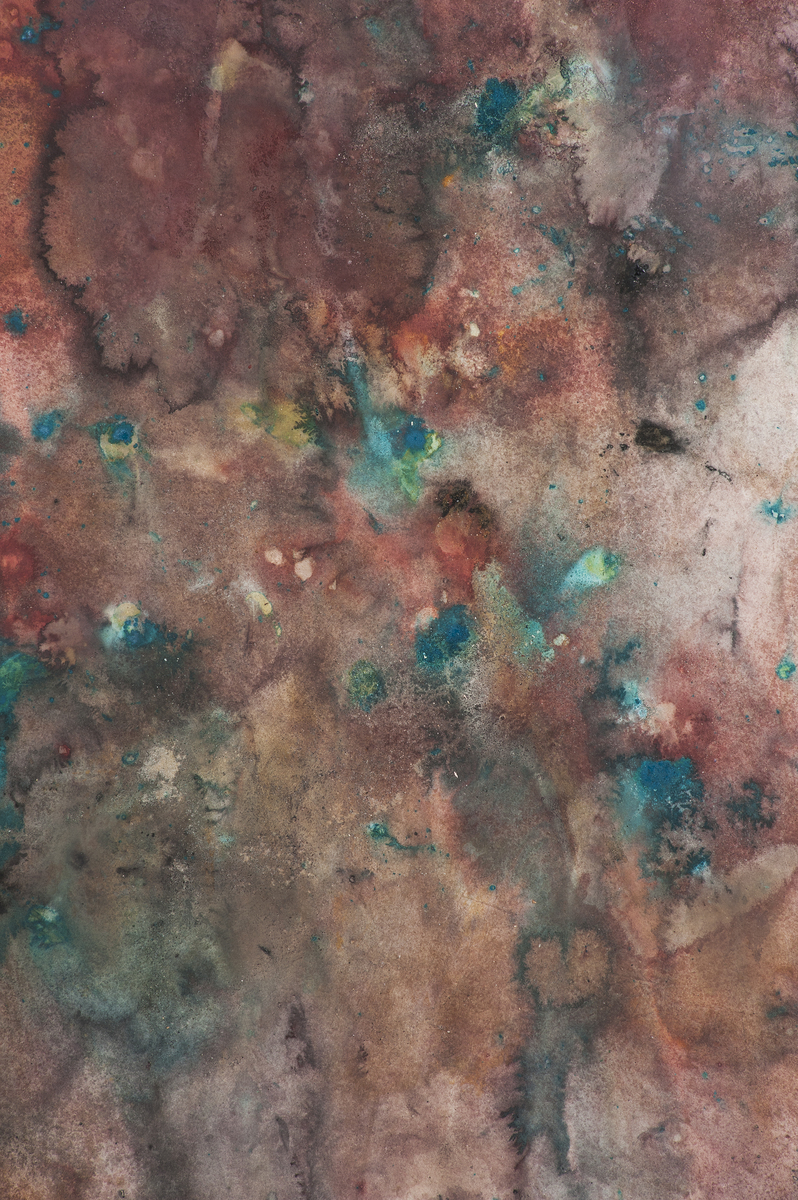
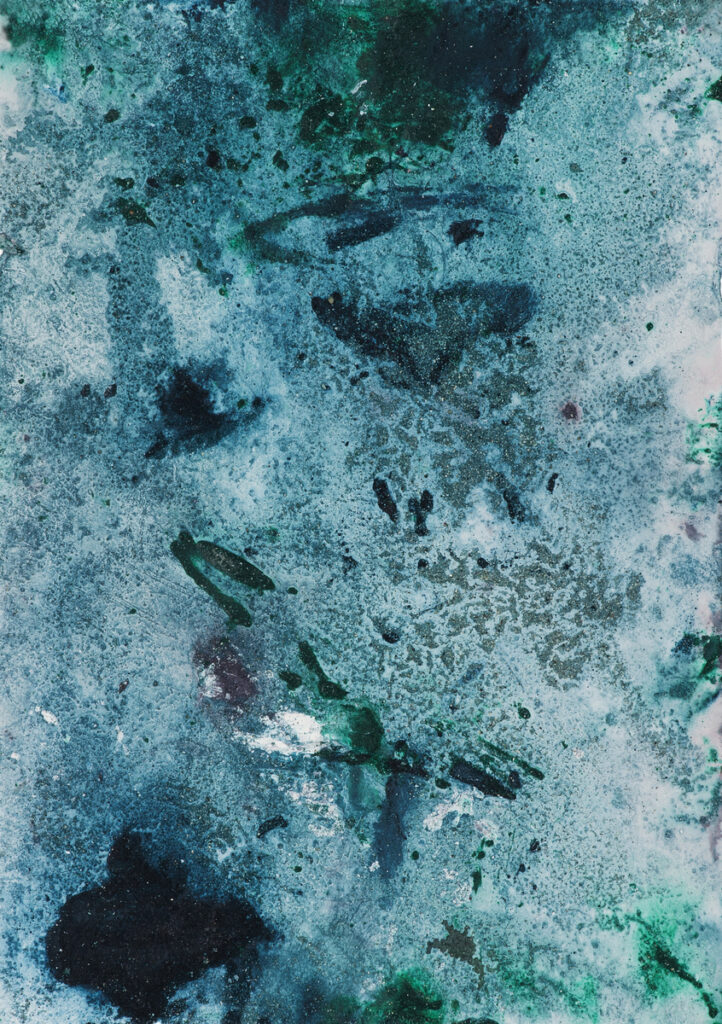
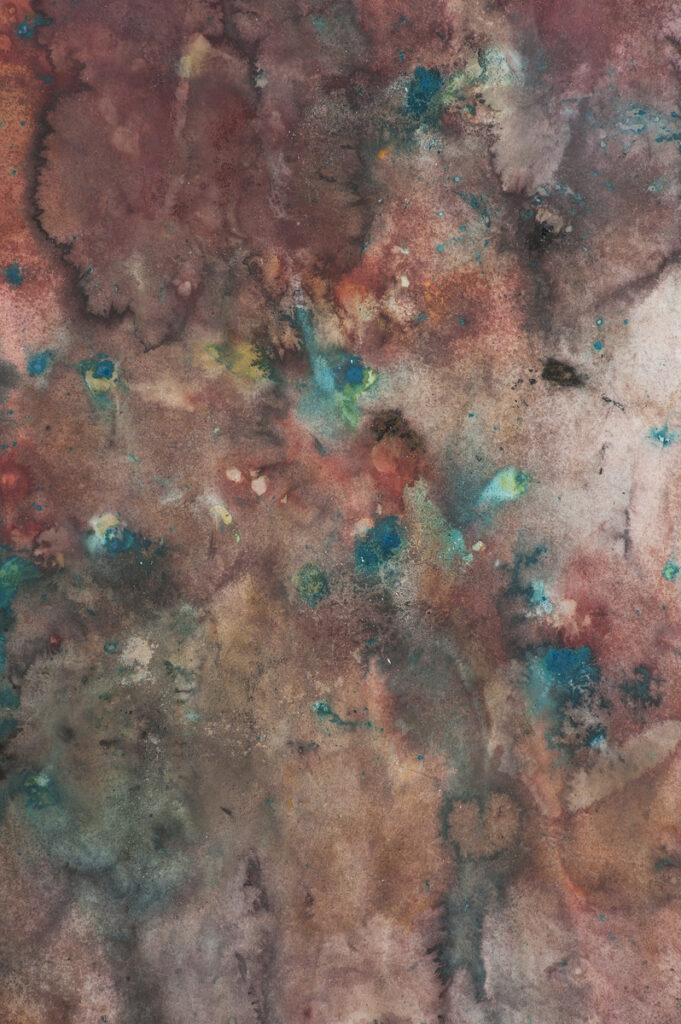
I utstillingen Weather Dependent utfolder verkene seg i rommet mellom land og vær. Maleriene er skapt utendørs på Nøss, Andøya og er formet av regn, vind, lys og svingende temperaturer. Forhold som ikke kan kontrolleres, men må møtes med oppmerksomhet. Overflatene bærer spor av tid, eksponering og samspill. Maleriet blir en måte å arbeide med klimaet på, snarere enn å avbilde det. Naturen blir en samarbeidspartner som gir rytme og motstand.
Utstillingen sammenfaller med lanseringen av Arctic Impressions, en samling haikudikt skrevet i etterkant av arbeidet i nord. Diktene beskriver ikke bildene, men tilhører den samme atmosfæren som formet dem – korte, presise inntrykk av vær, lys og nærvær. Sammen danner maleriene og haikuene en stillferdig samtale med nord – en refleksjon over forgjengelighet, lytting og miljøets subtile kraft.
Som kunstner innen maleri, fotografi og poesi kombinerer hun forskningsbasert innsikt fra internasjonal politikk og påvirkningsarbeid med et sterkt visuelt og narrativt uttrykk. Hennes praksis bygger bro mellom kunst, vitenskap og samfunn, og utforsker særlig nordområdene som geopolitisk og økologisk rom. Arbeidet hennes synliggjør sammenhengen mellom miljømessig bærekraft, sosial rettferdighet og demokratisk ansvar.
«I stedet for å male landskapet eller det konkrete miljøet som sees, maler jeg i samarbeid med elementene, en plein air. Jeg arbeider med de naturlige kreftene som oppstår under og gjennom hele maleprosessen. Sand, vind, snø, is, regn og bølger er ikke bare materialer — de er mine samarbeidspartnere. Jeg ser på dem som aktive deltakere, som hver bidrar med sitt eget perspektiv sammen med mitt.»
Day Picture IV 48×36 cm Acrylic, Paper, Sand & Sea 2022
Snow & Sand Picture II 56×72 cm Acrylic, Paper & Snow 2022
Anne-Mette Kelter tells us the story of her stunning world of Polaroid Photography.
When I first started to dive into the wonderful medium of Polaroid photography, I bought the «BIBLE» within Polaroid photography. That book is called “The Missing Manual” written by Rhiannon Adam. It was a book explaining about Polaroid-world. All the various camera, films, and the many creative techniques that can be used for this amazing medium.
I especially found the chapter about Polaroid decay interesting. The technique showed so much potential, and had an outcome that speaks very well to the way I wish to work. I am a very patient person and this process requires more than a lot of patience since it can take up to 6 months from start to finish to create a piece ready for framing.
The stunning process
I was stunned about the fact that leaving the polaroid in just a little water in a lunchbox with a lit on to soak for a couple of months would make the chemistry dissolve and mix with the water giving the polaroid a whole new and completely unique look that could never be recreated. The original decays are really to be considered alongside paintings since it is an analogue process with a unique and individual outcome.
Some time ago, I was struggling to precisely describe what my decay work represented. I talked to a friend about it, and she described it as «Somewhere between dream and reality». And that is acutally a very precise description. Spot on, really!
Anne-Mette Kelter with one of her vintage cameras at OSCAR studio&gallery i Lillestrøm, Norway
I hope for my work to be like a dream, for me and for my audience.
Anne-Mette Kelter
I hope for my work to be like a dream for me, and for my audience. I may see something in a decay that no one else can see and vice versa. That is the whole idea about my decaying process. I hpoe the viewer will be taken on a personal journey, where they will discover elements in the polaroids that speak to them on a personal plan. I aim for my work to be like going on a private journey into a land of dreams and fantasy when looking at my pieces.
Wait wait wait…
I put my polaroid in water – and I wait….and wait…. And weeks later I begin to see a small change/disruption in the photo. I often leave the polaroid in water for around 8 weeks. Then I take them out of the water and leave them to dry for another couples of months. All this before they can be scanned, enlarged etc.
When doing my first Polaroid decay I was thrilled to see the outcome. I knew at once that this was a technique that I wanted to develop more. My motivation was to find my own look, and thus my own and identifiable creative language as an artist.
When something disappears, you find something new
Sometimes I leave the polaroid soak for such a long time that the original motif has completely disappear. Then the emphasis is on the colors and the structures of the shot. On other occasions I take the polaroid out of the water when the original motif is still visible.
Depending on what look I wish for the polaroid to have, I can either take it to the extreme to show the structures. Or I can leave the motif visible to emphazise the story I wish to tell.
I consider myself a storyteller through my polaroids. I love the dramatic and abandoned landscapes of Connemara, where I live. And I am thankful that I live right in the middle of my «canvas» so to speak. I moved from Copenhagen to Western Ireland in the beginning of 2022. Here I will pursue my overall passion for landscape-polaroid photography.
To see more of my work and prices visit OSCAR studio&gallerys webshop.
If you wish to purchase an original, please enquire at [email protected]